

Nashville invented Miss Gay America. Not Manhattan. Not San Francisco. Nashville, in a bar on 2nd Avenue, in June of 1972. It is one of the most significant events in American drag history and most people who live here have never heard about it.
Music City has been telling stories about its own nightlife for a century, and somehow the drag chapter keeps getting left out of the official version. So here it is, properly, from the alley to the main stage.

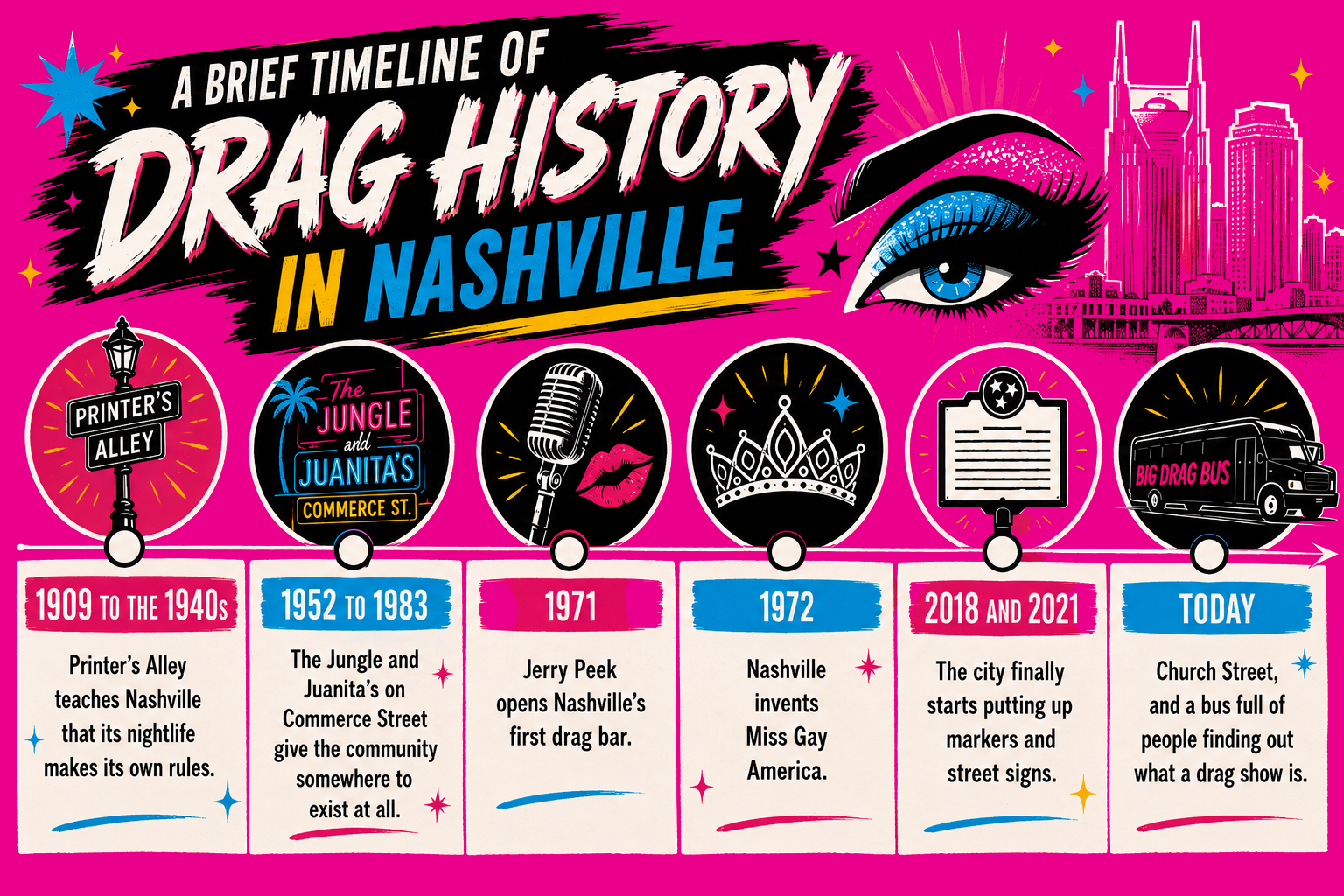
Any honest account of Nashville nightlife starts in Printer’s Alley. The narrow stretch between Third and Fourth Avenue was the city’s publishing centre by 1830, and at its 1915 peak it held two major newspapers, ten print shops, and thirteen publishers.
Then the presses left and the nightlife moved in. Tennessee went dry in 1909, and the alley’s hotels and saloons quietly kept pouring anyway. By the 1940s it was a full nightclub district, and it stayed that way for decades: burlesque, striptease, jazz, and a police force that mostly looked the other way.
Here is the part that usually gets fudged. Printer’s Alley was not where Nashville drag began. The alley’s stages belonged to burlesque performers and musicians. It matters to this story because it is where Nashville learned that its nightlife could run on its own rules, in its own corners, whatever the law said at the time. That lesson is the inheritance. The drag story proper starts a few blocks away.

In 1952, a straight man named Warren Jett opened a restaurant and cocktail bar called The Jungle at 715 Commerce Street. Next door at 713, Juanita Brazier opened a beer bar. She named it after herself.
Neither opened as a gay bar. Both became one. By the early 1960s, The Jungle and Juanita’s were known as the first gay bars in Nashville, and they sat directly across from the Greyhound station, which was not an accident. Young gay men arriving from rural Tennessee got off the bus and knew exactly where to walk.
This was a time when being seen holding hands could end your career. The bars were not nightlife. They were infrastructure.

Jett sold The Jungle in 1960, after his brother Leslie was elected sheriff. Leslie Jett then started raiding bars for “disorderly conduct,” which was the charge police used when what they meant was homosexuality.
In August 1963, officers raided Juanita’s and arrested 27 men. A fine or a night in jail was the smallest part of it. An arrest meant your name in the paper, which meant your family and your employer found out.
Juanita Brazier bailed her customers out. She did not ask to be repaid. She ran that bar for more than 35 years.
Both buildings came down in 1983 when the block was leveled. For 35 years there was nothing to mark them. Then, on December 7, 2018, a historical marker went up at 715 Commerce Street, only the second marker in Nashville honoring the city’s LGBTQ+ history.

Jerry Peek, a Nashville native, opened the Watch Your Hat and Coat Saloon at 139 2nd Avenue in 1971. It was Nashville’s first gay dance and show bar, and the first place in the city built around drag performance.
It opened as a country and western bar. Peek was not a performer himself. What he had was an eye for the room, and the room told him what it wanted.
It worked immediately, and not only with gay patrons. Straight Nashville came too.

Peek had travelled to clubs around the country and noticed something missing. There were talented female impersonators everywhere and no national recognition for any of them. State-level pageants existed. Nothing tied them together.
So he built the thing that did. His method was almost absurdly analog: there was a small national directory of gay nightclubs called David’s, and Peek went through it, found every bar that listed drag shows, and mailed each one a letter announcing a pageant.
Contestants came from 22 states.
On June 25, 1972, the first Miss Gay America pageant was held at the Watch Your Hat and Coat Saloon. Norma Kristie, performed by Norman Jones of Arkansas, took the first crown. Charlie Brown was first runner-up.
By Peek’s own account, it went fairly smoothly, with one exception: a contestant rigged a working sprinkler behind the curtain and performed “Singing in the Rain.” The show stopped for twenty minutes while they mopped the stage. Modern Miss Gay America has strict rules about set-up and takedown times. Now you know why.
Jones bought the pageant from Peek in 1975 and spent thirty years turning it into the most prestigious competition of its kind. Peek has always been clear that Jones is the reason it survived. But Peek built it, and he built it here.
Miss Gay America is the first national pageant for female impersonators and the longest-running pageant of its kind. It started in a Nashville bar.
| The part that gets lost. Nashville is not a city where drag showed up recently. It is a city where a national drag institution was invented in 1972, more than fifty years ago, by a local who could not find a stage big enough and decided to build one. |

The saloon burned down in May 1973. Peek moved the drag shows to the Embers Cabaret Room and kept going.
The decades after brought the scene through disco, through the AIDS epidemic, and through the slow migration to where it lives now. One name from that stretch is worth knowing: Mark Middleton, who performed as Bianca Paige, the Pantomime Rage, and became a fixture of Nashville drag and an HIV/AIDS activist. In June 2021, the city named a street after her. Bianca Paige Way is a real address in Nashville.

Nashville’s LGBTQ+ life now centres on the 1500 block of Church Street, just north of Music Row. Drag runs continuously here, from club nights to drag brunch to what the city has taken to calling transportainment, which is where we come in. Big Drag Bus checks in at 1517 Church Street, between Tribe and Play, in the middle of the block this history built. Our drag queen hosts are Nashville performers working in a lineage that runs straight back to a saloon on 2nd Avenue in 1971.
| Did you know? Before becoming international stars, several RuPaul’s Drag Race queens, including Brooke Lynn Hytes, Aura Mayari, The Princess, Jaidynn Diore Fierce, Jorgeous, Aurora Sexton, and Deception, performed regularly on Nashville stages, proving that Music City is still one of the South’s premier drag destinations. |
Frequently Asked Questions About Nashville’s Drag History
Where did drag start in Nashville?
Nashville’s first drag bar was the Watch Your Hat and Coat Saloon, opened by Jerry Peek at 139 2nd Avenue in 1971. It was the city’s first gay dance and show bar. The broader LGBTQ+ nightlife it grew out of started on Commerce Street in the 1950s at The Jungle and Juanita’s.
Was Miss Gay America really founded in Nashville?
Yes. The first Miss Gay America pageant was held on June 25, 1972, at the Watch Your Hat and Coat Saloon in Nashville. Founder Jerry Peek recruited contestants by mailing letters to gay clubs listed in a national directory, and performers came from 22 states. Norma Kristie, performed by Norman Jones of Arkansas, was the first winner. It is the first national pageant for female impersonators and the longest running of its kind.
What were The Jungle and Juanita’s?
They were neighbouring bars at 713 and 715 Commerce Street, opened in 1952 and 1956, and known by the early 1960s as the first gay bars in Nashville. Both were repeatedly raided by police. In 1963, 27 men were arrested at Juanita’s. The buildings were demolished in 1983, and a historical marker was placed at the site in December 2018.
Is there anywhere in Nashville to see this history in person?
Yes. The Jungle and Juanita’s historical marker stands at 715 Commerce Street. Bianca Paige Way, named for the late drag performer and HIV/AIDS activist Mark Middleton, is in Nashville. Nashville Sites and Nashville Queer History also run a self-guided LGBTQ history driving tour of the city.
Why is Printer’s Alley associated with Nashville drag?
Loosely, and mostly by reputation rather than record. Printer’s Alley was Nashville’s nightclub and burlesque district from the 1940s onward, and it established the city’s appetite for after-hours performance. The documented drag lineage, though, runs through Commerce Street, 2nd Avenue, and Church Street rather than the alley itself.
Where is the Nashville drag scene now?
Mostly the 1500 block of Church Street, just north of Music Row, alongside spots in East Nashville. The block holds bars, drag brunch, and drag-hosted tours, and it is where Big Drag Bus checks in at 1517 Church Street.
| Ride through the neighbourhood that made it. Big Drag Bus checks in at 1517 Church Street, in the middle of the block this history built. Ninety minutes, live drag, and downtown Nashville out the window. Explore the tours | 1517 Church St, Nashville | 629-333-2525 |


